Thursday, March 3, 2016

Real nominal (r) vs Nominal (i) Intrest rate

REAL(r) vs. NOMINAL(i) INTEREST RATE
Real Interest Rate : r% = i% - pi%
Determines the cost of an investment decision = The Real Interest Rate


INVESTMENT DEMAND CURVE (ID)
Ø  Downward Sloping
Ø  When interest rates are high, fewer investments are profitable

SHIFTS IN INVESTMENT DEMAND (ID)

Costs of Production                                                         Business Taxes
*Lower costs, IDà                                                              *Lower Business Taxes, ID à
*Higher costs, IDß                                                             Higher Business Taxes, ID ß

Technological Change                                                    Stock of Capital
New Technology, IDà                                                       Economy low on Capital, ID à
Lack of technology, IDß                                                   Economy has alot ofCapital, ID ß

Expectations
Positive, ID à
Negative, ID ß
CLASSICAL
Ø  Classical believes competition is good.
Ø  Believes in invisible hand(Automatic Regulation)
Ø  In the long run, the economy will balance at full employment
Ø  Trickle- Down Effect(Help Rich First, Everybody Else Second)

KEYNESIAN
Ø  AD is Key, Not AS.
Ø  Leaks and Savings cause Recessions.

Ø  In the Long run, we are all dead.

Wednesday, March 2, 2016

Investment and Investment Demand

In recession prices are fixed, wages are fixed, employment level is flexible
intermediate- prices are flexible, wages fixed, employment level is flexible
inflation- prices are flexible wages, wages are fixed, employment level is fixed
nominal wages- The amount of money received by a worker per unit of time.
Real wages- the amount of goods and services a worker can purchase with their nominal wage
Sticky wages- Nominal wage level that is set according to an initial price level and it does not vary due to labor contracts or other restrictions
Investment
Money spent or expenditure:
  • New plants (factories)
  • capital equipment (machinery) 
  • Technology ( hardware and software)
  • New homes
  • Inventories (goods sold by producers) 
expected rates of return:
  • cost/benefit analysis
  • expected rate of return (determining benefits)
  • interest cost
  • compare expected rate of return to interest cost 
$ expected return < interest to cost (no investment)
$ expected return > interest cost invest
$ This is used when determining the amount of investment an investor should undertake 

Taxes and Subsities

Taxes($ to government) on business increase per unit production cost SRAS ⬅ subsidies from government to business reduce per unit production cost SRAS
Goverment Regulation
Creates a cost compliance = SRAS <
Deregulation reduces compliance cost = SRAS >
Full employment
 equilibrium exist where AD intersects SRAS & LRAS


Tuesday, February 23, 2016

Aggregate Supply

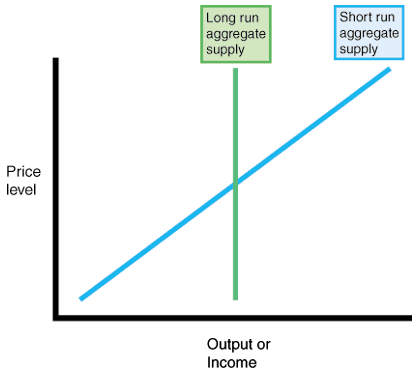
Aggregate Supply- The level of GDR that firms will produce at each price level (PL)
Long-Run
Period of time where input prices are completely flexible and adjust to changes in the price level. In the long run the level of real GDP supplied is independent of the price level
Short-run
Period of time where input prices are sticky and do not adjust to changes in the price level. In the short run level of real GDP  supplied directly to the price level
The LRAS (long run aggregate supply) marks the level of full employment in the economy (analogous to PPC) because input prices are completely flexible in the long-rin changes firms real profits and therefore do not change firms level of output thid means LRAS is vertical at the economy level of full employment
Changes in SRAS
An increase in SRAS is seen as a shift to the right and a decrease is seen a shift to the left
Determinants of SRAS:
  1. Input prices
  2. Productivity
  3. legal institutional environment 
Domestic resource prices
  • wages 75% of business cost
  • Cost of capital 
  • raw materials
Foreign Resource Prices (FRP)
Increase in FRP shifts SRAS <
decrease in FRP shifts SRAS >
more productivity = lower unit production cost = SRAS >
low productivity = SRAS<


Wednesday, February 10, 2016

  • represents the transactions in an economy 
-Product Market: place where goods and services are produced by businesses 
-Factor Market:  place where households sells resources and businesses buy resources  
-Firms: organization that produces goods and services for sale 
-Households:  a person or a group of people that share their income 

  •    sells factor as production to businesses  
Unanticipated Inflation

Who is hurt by inflation:
1. Savers
2 Creditors/Lenders
3.People on a fixed income (Elderly, Welfare)

Who is helped by inflation:
1. People who owe debts

GDP And Unemployment

Gross Domestic Product (GDP) is the broadest quantitative measure of a nation's total economic activity. More specifically, GDP represents the monetary value of all goods and services produced within a nation's geographic borders over a specified period of time.

Other Info on GDP
Real GDP = P X Q
Nominal = P X Q
The value of output produced in current prices can increase from year to year it is the value. In constant based year prices price doesn't change but quantity does it can increase from year to year.

If you want to measure economic growth use real GDP
If you want to measure Inflation use nominal Real GDP adjusted for inflation
GDP deflator- price index used to adjust from nominal to real GDP

 Formula for GDP Deflator *
In base year always equal 100 In years after base year GDP is greater