Sunday, May 15, 2016

comparative and absolute advantage

Absolute advantage
when a person can produce more of a certain good/service than someone else in the same amount of time
national- When a country can produce a good/service than another country can in the dame period of time
Comparative Advantage
when it cost less to produce a product than to buy it at a lower opprotunity cost
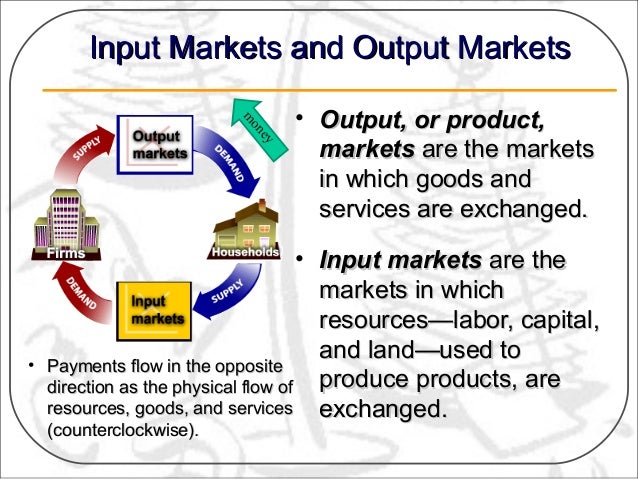
 Examples of input and output
Input:

  • # of hours to do a job
  • # of acres to feed a horse 
  • #of gallons to paint a house
Output:

  • tons per gallon or mph
  • TV's produced per hour


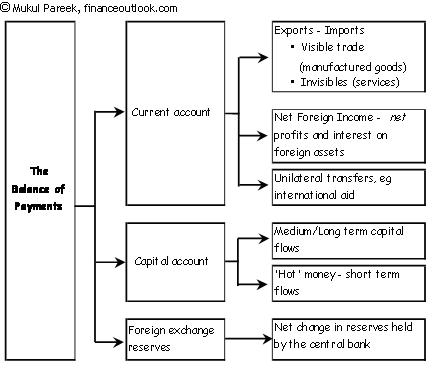
Mechanics of foreign exchange

The buying and selling of currency any transaction that occurs in balance of payments necessitates foreign exchange The exchange rate (e) is determined in the foreign currency markets changes in exchange rates
Exchange rates are a function of the supply and demand for currency. A increase in the supply of currency will decrease the e of currency, a decrease in supply will increase the e of currency
An increase for demand for a currency will increase e rate of currency, an decrease for demand decrease e for currency
appreciation of a currency occurs when the exchange rate of that currency increase (e goes up)
depreciation of a currency occurs when the exchange rate  of the currency decreases (e goes down)
Supply and Demand shifts-

    • consumers tastes 
    • relative income
    • relative price level
    • speculation
exports and imports
exchange rates are determinants of exports and imports appreciation of the dollar causes american goods to be relativity more expensive and foreign goods to be less. Which reduces exports and increases imports
Depreciation of the dollar causes american goods to be cheaper than foreign making an increase in exports and decrease in imports.


Extending the analysis of AS

Short run
Period in which wages remain fixed as price level increases or decreases. Price level changes allow for companies to exceed normal outputs and hire more workers because profits are increasing while wages remain constant. In long run wages will adjust accordingly. The long run As curve is represented with a vertical line at full employment level of real GDP
Inflation
Demand pull- prices increase based on increase in aggregate demand in the short run, demand pull will drive up the prices of and increase production . If long run increases aggregate demand will.
Cost push - arises from factors that will increase per unit costs such as increase in the price of a key resource shift left. in effort to fight cost-push the government can react in two different ways:

  • by spending which could create a inflationary spiral
  • no action which leads to recession by keeping production
Long run Phillips Curve
Because the long run Phillips curve  exists at natural rate of unemployment (un) structural change in the economy that effect Un will also cause LRPC to shift
Increases LRPC

  • Inflation-rises level 
  • Deflation- decline in price level
  • Disinflation- decrease in inflation rate over time
  • Stagflation- inflation and unemployment at equal

Friday, April 8, 2016

Single Bank and Banking system

When a customer deposits cash or withdrawals cash from their demand deposit account, it has no effect on money supply. It only changes: 
1.    The composition of money
2.    Excess reserves
3.    Required reserves
Single Bank
·   Loan from your excess reserves. (ER)
Banking system 
   Money increases by the multiple in the change of ER; ER * multiplier.
FED
When the FED buys or sells bonds, ER is created. # bought/sold * multiplier

Fiscal policy vs Monetary policy

n the early 21st century, here in the USA: 
An efficient, "full employment" economy will probably have: 
1.    An annual unemployment rate of 4-5%.
2.    An annual inflation rate of 2-3%.
If the economy goes into recession: 
3. The real GDP will decrease for at least 6 months.
4. The real unemployment rate will go to 6% or more.
5. The inflation rate will probably go to 2% or less.

If congress enacts Keynesian Fiscal Policies to attempt to slow/stop the recession, then:
6. The policy will try to improve C, or G (parts of AD0 
7.Congress will out federal taxes.
8. Congress will increase job and spending programs.
9. The federal budget will probably create a deficit.
10. Due to changes in Money Demand, interest rates will increase.

If the Federal Reserve Employs Monetary Policy options to slow/stop the recession, then:
11. The policy will target improvements in IG (part of AD)
12. The Fed will target a lower federal fund rate.
13. The Fed can lower the discount rate.
14. The Fed can buy bonds (Open Market Operations).
15. The Fed can lower the reserve requirement, but probably wont because it is too complex for the banks. 
16. These Fed policies will lower the interest rates through changes in the Money Supply.
17. These options should increase Ig.


If the economy suffers from too much demand-pull inflation or cost-push inflation, then:
18. The unemployment rate will go to 4% or less.
19. The inflation rate will probably go to 4% or more.
If Congress enacts Keynesian Fiscal Policies to attempt to slow/stop the inflation problems, then:
20. The policy will try to decrease C, or G (parts of AD)
21. Congress will increase federal taxes. 
22. Congress will decrease job and spending programs.
23. The federal budget will probably create a surplus.
24. Due to the changes in Money Demand, interest rates will decrease.

If the Federal Reserve Employs Monetary Policy options to slow/stop the inflation problems, then:         
25. The policy will target decreases in IG (part of AD).
26. The Fed will target a higher federal fund rate.
27. The Fed can increase discount rate.
28. The Fed can sell bonds (Open Market Operations).
29. The Fed can raise the reserve requirement, but probably wont because it is too complex for the banks. 
30. These Fed policies will raise the interest rates through changes in Money Supply.

31. These options should decrease Ig.
Crowding Out

What is it?
   A critique falls of Keynesian policies that are applied to fight a recession. (An expansionary policy)
Why does it happen?
·   The policy of cutting taxes and raising spending will create a budget deficit.
So?
   The budget deficit must be funded and to do this Congress orders the sale of US bonds. (This is NOT a Monetary Policy tool used by the Fed)
This money comes from? 
   Mostly from US citizens and companies and investment firms.
Therefore?
·      Money that could be spent on consumption or used for Private Savings is now being used to buy bonds.
On the Money Market?
·      This will cause the $ demand curve to shift outward. Remember this is a Fiscal event!
On the Loanable Funds Market? 
   This will cause the supply curve to shift inward because we are not saving money privately anymore.
Also, on the Loanable Funds?
   This can cause the demand curve to shift outward because the private and public demand for $ increases.
On both graphs?
   The nominal and real interest rate will increase.
Therefore, on the investment D graph
   The increase in nominal and real interest rates will cause Ig to decrease.
Isn't this counterproductive? 

   Yes
Why do it? 
   Fiscal Policy supporters (Keynesians) insist that gains in consumption (C) and spending (G) will outweigh any loss in the future Ig.
Why?
   C and G are greater than IG and they are short run improvements. IG is longer run and Keynesians don't worry about that. In the long run we are all dead.
Anymore?

Yes, this is summarized on the Aggregate Model. The AD will move outward due to the increases in C and G and the "maybe" move inward due to a loss of IG, but not as much as the increase. Therefore, the economy improves.

Thursday, April 7, 2016

Tool of Monetary Policy

1. The Reserve Requirement
   Only a small percent of your bank deposits is in the safe. The rest of your money has been loaned out. This is called Fractional Reserve Banking.
   FED sets amount that banks must hold.
   The RR is the percent of deposits that banks must hold in reserve and NOT loan out.
   When the FED increases the money supply it increases the amount of money held in bank deposits.
1. Decreasing Reserve Ratio
1.Banks hold less money and have more excess reserves
2.Banks create more money by loaning out excess
3.Money supply increases, interest rates fall, AD goes up
2. Increasing Reserve Ratio
   Banks hold more money and have less excess reserves
   Banks create less money
   Money supply decreases, interest rates increase, AD goes down

2. The Discount Rate- The interest rate that the FED charges commercial banks.

To increase the money supply, the FED should decrease the discount rate. (Easy money supply)
To decrease money supply, the FED should increase the discount rate. (Tight money supply)

3. Open Market Operations
   The FED buys/sells government bonds. (securities)
   To increase money supply, the FED should buy government securities.
   To decrease money supply, the FED should sell government securities.

Reserve Requirement

The FED requires  banks to have money to meet customers demands for cash  the amount requierd is the reserve ratio.
The required reserve ratio the old demand deposits checking account balances must not be loaned out typically reserve ratio is 10%

Financial Sector

Financial Assets- stocks or bonds that provide expectations  of future benefits. It benefits the owner only if the interest rate if the assessment certain obligation

Financial liabilities- it is in curved by the issuer of the asset which liability is owned
interest rate- the price paid for the use of a financial asset.

Stocks - financial assets that convey a assets in a corporation
Bond- is the promise to pay a certain amount of money plus interest

A bank is a financial intermediate uses  liquid assets  (bank deposits) to finance  the investments of the borrowers. In a process known as fractional reserve
Banking- a system in which depositors institution  hold liquid assets  less then the amount of deposits can take the form of currency in banks vaults
Banks Reserve- deposits held at the Federal Reserve


Money And Demand

What happens to the quantity demanded of money when interest rates increases?
 Quantity demanded falls because  its would prefer to have interest earning assets of borrowed liabilities

What happens to the  quantity demanded when interest rate decreases?
quantity demanded increases there is no incenitive to convert cash into interest if the price level increases
 M2 shifts to the right:

  • Changes in PL
  • Changes in income 
  • changes taxtation that affects investments 
If the FED increses the money supply a temporary surplus of money will occur at 5% interest.
The surplus will cause the interest rate will fall Increase MS > deccrease
If the FED decreases Money supply
Decrease MS> increase interest rate > decrease investment> decrease AD

Money

3 Uses of money

  1. Medium of exchange
  2. Unit of account - establish economic worth in exchange process
  3. To barter or trade - money holds value over a period of time products do not
Types of money

  1. Commodity Money - Value is from the type of material its made from. (ex gold coins)
  2. Representative Money- Paper money backed up by something tangible that gives it value
  3.  Fiat Money- Money cause the government says so
Characteristics of Money
1.portable          2.Durable
 3.scarce             4. Divisible
5. Acceptable       6. Uniform
Money supply
M1- consist of currency ( cash and coins) Checkable deposits most liquid travelers check
M2- consist of M1 money along with savings account market and deposits held by banks out side U.S and is not liquid
M3 - consist of M2 + certificate\ of deposit held by an private institution
A dollar today is worth more than one tomorrow because of inflation this the reason for paying interest Time value of money Let V= future value nof money P= present value of money R= real interrest rate nominal - interest rate
n=years
K number of times intrest is credited per year
Simple interest V=(1+r\k)^n*p
compound interest V=(1+r\k)^nk*P
Demand for money Has an inverse relationship between nominal intrerest rates and the Quanity of money demanded. 

Thursday, March 3, 2016

Fiscal policy

      Change in Expenditures or tax revenues of the Government.
-       2 Tools of Fiscal Policy: 1) Taxes: Government can increase or decrease taxes
-       2) Spending: Government can increase or decrease spending.
-       The Fed = Federal Reserve
-       Fiscal Policy = Run by the Fed and the President

Deficits, Surpluses, and Debt
Ø  Balanced Budget: Revenues = Expenditures
Ø  Budget Deficit: Budget Revenue < Expenditures
Ø  Budget Surplus: Budget Revenue > Expenditures
Ø  Government Debt: Sum of all Deficits- Sum of all Surpluses
Ø  Government must borrow money when it runs a budget deficit.
o   1) Individuals (taxes)
o   2) Corporations
o   3) Financial Institutions
o   Foreign entities or Governments

Fiscal Policy
Ø  Discretionary Fiscal Policy(action)
o   Expansionary Fiscal Policy – Deficit
o   Contractionary Fiscal Policy – Surplus
Ø  Non-Discretionary Fiscal Policy(No Action)

Discretionary vs. Automatic Fiscal Policy
Discretionary
Increasing or decreasing Government spending and/or taxes to return economy to full employment. This involves policymakers doing Fiscal Policy in Response to an economic problem.

Automatic
Unemployment compensation and Marginal tax rates are examples of automatic policies that help mitigate the effects of recession and inflation. Automatic Fiscal Policy takes place without policymakers having to respond to current economic problems.


“Easy”
“Tight”
Expansionary
Fiscal Policy
Contractionary
Fiscal Policy
*Combat a recession
*Combat Inflation
*Government Spending
INCREASES
*Government Spending
DECREASES
*Taxes Decrease
Taxes INCREASE

·         Progressive Tax System – Average tax rate (tax revenue / GDP) rises with GDP.
·         Proportional Tax System – Average tax rate remains constant as GDP changes
·         Regressive Tax System – Average tax rate falls with GDP.

Disposable Income(DI)

DISPOSABLE INCOME
Disposable Income is the income after taxes or net income
DI = Gross Income * Taxes
Two Choices
With Disposable Income, households can…
1.    Consume(Spend money on goods and services)
2.    Save (Not Spend money on goods and services)

Consumption
Household Spending- The ability to consume is constrained by:\
1.    The amount of disposable income
2.    The propensity to save

-Households do consume if DI = 0
*Autonomous Consumption
*Dissaving

Saving
Household not spending – The ability to save is hindered by
1.    The amount of Disposable Income
2.    The propensity to Consume
Do Households save if DI = 0 [NO]

APC [Average Propensity to Save] and APS [Average Propensity to Consume]

·          *APC + APS = 1                    *APC > 1(DISSAVING)           *1 – APC = APS
·         *(-APS) = DISSAVING                          * 1 – APS = APC

MPC [Marginal Propensity to Consume] – The fraction of any change in DI that’s consumed.

·         MPC = Change in Consumption / Change in Disposable Income

MPS[ Marginal Propensity to Save] – The fraction of any change in disposable income that is saved.

·         MPS = Change in Savings / Change in Disposable Income
·         Marginal Propensities
·         MPS + MPS = 1
·         MPC = 1 – MPS
·         MPS = 1 – MPC
·         People do 2 things with their Disposable Income, Consume it or Save it!

The Spending Multiplier Effect

-       An initial change in spending [ C , Ig, G, Xn ] causes a larger change in AS or AD
-       Spending Multiplier can be calculated from the MPC or MPS.
-       Multiplier = AD / Change in (C, Ig, G, or Xn)

-       Multiplier = 1 / (1 – MPC)    or 1/ MPS

-       Multipliers are positive (+) when there is an increase in spending and negative (-) when there is a decrease.

-       Tax Multiplier: When Government taxes, the multiplier works in reverse because money is now leaving the circular flow.

-       Tax Multiplier(Note: is Negative)    - Note: if there is a tax cut, then multiplier is positive, because there is now more money in the circular flow.

-       Tax Multiplier = -MPC / (1 – MPC)  or –MPC / MPS